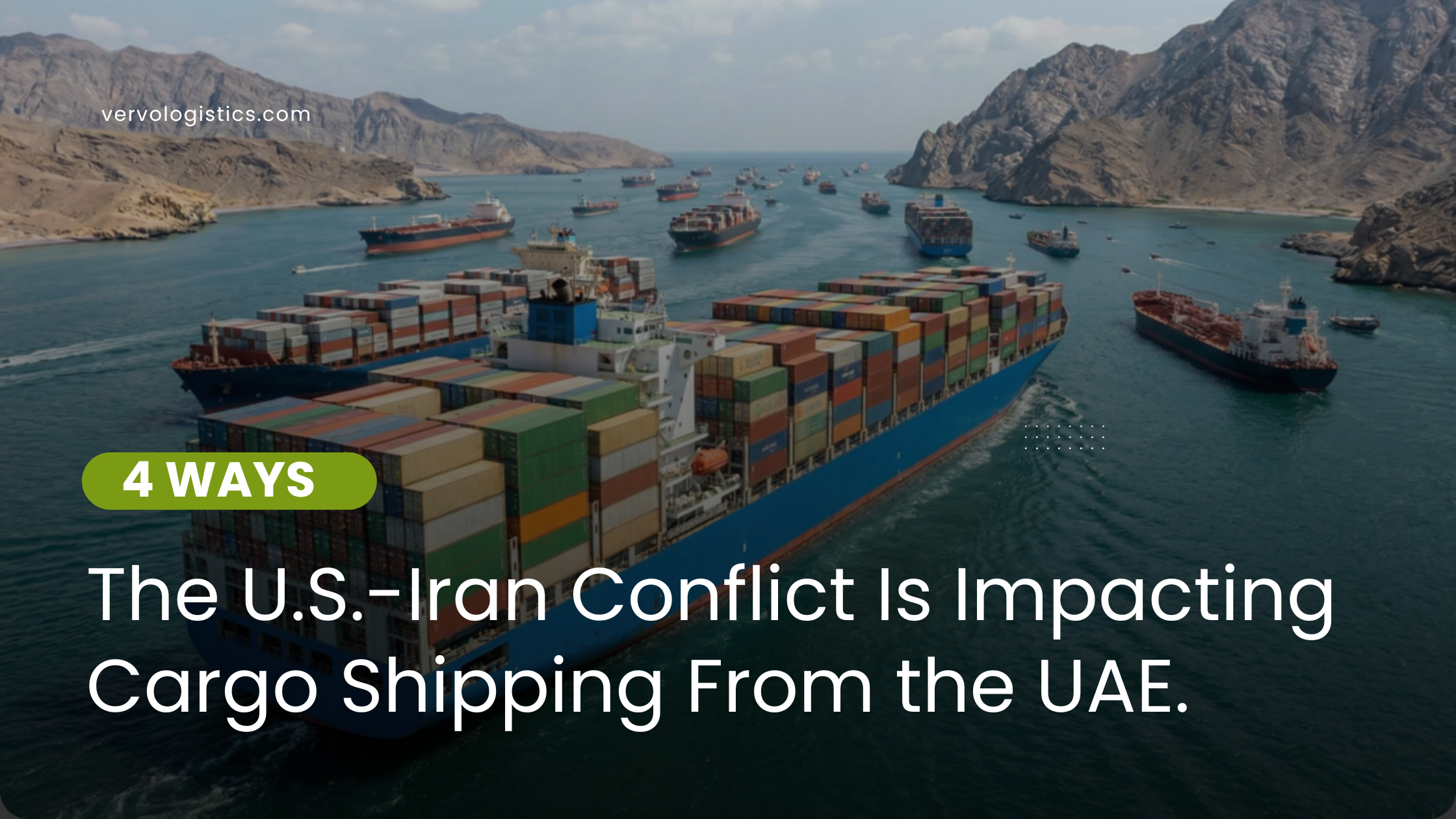
The current U.S.-Iran conflict is putting new pressure on the logistics sector in the region. This is the picture from our perspective in short: key maritime routes have become more sensitive, insurance and war-risk costs are rising, and shipping schedules across sea and air freight are becoming harder to predict.
The conflict is disrupting the movement in the Strait of Hormuz. This matters because the Strait of Hormuz remains one of the world’s most critical chokepoints and the main maritime gateway for Gulf trade.
It carries about 20 million barrels of oil per day, about 20% of global petroleum liquids consumption, and roughly one-fifth of global LNG trade.
In this article, we explain the four main ways this conflict is affecting shipping and logistics in the region and what that means for people moving cargo abroad from the UAE.
Impact 1: Longer Transit Times and Less Predictable Shipping Schedules
Why is this happening? Shipping schedules across the Middle East have become less predictable because the conflict has affected both the Strait of Hormuz and major Gulf air corridors.
Sea Shipping:
On the sea freight side, the Strait of Hormuz remains the main maritime gateway in and out of the Gulf, so any security threat there can slow vessel movement, delay departures, and lead carriers to pause or reassess services.
Lloyd’s List reported that around 60 containerships were waiting near the southern entrance to the strait at one stage, with no active containership transits being tracked at that point.
Although the Strait accounts for only about 3% of global seaborne container trade, it still matters heavily for regional cargo because major hubs such as Jebel Ali and Khalifa Port depend on stable Gulf feeder and transshipment flows.
Air Shipping:
Air freight has also been affected. Over the past week, major airports, including Dubai, Abu Dhabi, and Doha, were closed or severely restricted after airspace disruptions across the region. Reuters reported that Middle Eastern carriers account for about 13% of global air cargo capacity, while Aevean estimated the conflict caused a 22% reduction in global air cargo capacity. By March 6, traffic at Dubai International had recovered only to about 25% of normal levels, even as operations gradually resumed.
That said, this is not a situation where trade simply comes to a halt. Cargo is still moving. But moving it now takes more care and smarter planning. Businesses have to stay flexible with routing and prepare for changes in timing and pricing.
Impact 2: Higher Freight, Insurance, and Emergency Shipping Costs
If a route may face disruption, delay, or sudden operational changes, the added exposure does not stay theoretical. It shows up in freight quotes and insurance premiums. That means the cost base becomes less stable than usual for shipments linked to the Gulf.
Reuters reported that war risk premiums jumped sharply, while some insurers reduced or withdrew cover, prompting the United States to offer up to $20 billion in reinsurance support for maritime losses in the Gulf.
The surcharge figures now in the market show how quickly costs can move. Lloyd’s List reported that Hapag-Lloyd introduced a war risk surcharge of $1,500 per TEU for standard containers and $3,500 per container for reefers and special equipment. ‘
CMA CGM introduced an emergency conflict surcharge of $2,000 per TEU, $3,000 per FEU, and $4,000 for reefers or special equipment on affected regional cargo.
Impact 3: Reduced Booking Availability and More Pressure on Transshipment Networks
Some carriers have also suspended bookings and kept vessels outside the Gulf while they reassess risk.
Reuters reported that COSCO suspended all new bookings on key Middle East routes, including routes linked to the UAE. Similarly, Maersk suspended two shipping services connecting the Middle East with Asia and Europe.
That creates more pressure on regional shipping networks that depend on feeder links and transshipment flows. Xeneta said the crisis left 147 container ships sheltering in the Gulf, which added to congestion.
UNCTAD has also warned that sustained disruption near Hormuz can affect feeder services and transshipment operations around Jebel Ali and Khalifa Port, with some cargo potentially rerouted through South Asian ports instead.
For UAE shippers, the booking space may be tighter, and cargo needs more lead time and more flexible routing than before.
Impact 4: More Rerouting
As conflict risk disrupts normal vessel movement through the Gulf, some shipments are being redirected through alternate ports, longer sea routes, or mixed road and sea solutions.
Carriers are also avoiding traditional corridors and diverting vessels around the Cape of Good Hope instead, which adds distance, transit time, and operating cost.
Reuters reported that major shipping lines, including Maersk, Hapag-Lloyd, CMA CGM, and MSC, have diverted vessels around southern Africa as regional security risks intensified.
For Gulf cargo, the adjustment is often more regional. Cross-border trucking across GCC markets remains open, with Egypt-Saudi-GCC multimodal routes serving as alternative connections for Europe and Asia flows.
Cargo is being redirected through operating gateways such as Khorfakkan, Fujairah, Sohar, Salalah, and Jeddah, with onward trucking used to reach final destinations across the GCC.
Reuters separately reported that MSC would offload Gulf-bound cargo at the nearest safe seaport, shifting the next leg and cost burden onto onward transport.
We Have Seen Similar Disruptions Before.
In the shipping sector, we have managed through major disruptions before, from the COVID-19 crisis and its supply chain shocks to the Red Sea disruptions that forced the market to rethink routes, timelines, and cost structures almost in real time.
Those periods made one thing very clear: agility is no longer optional in logistics. It is a core operating model. The businesses that continue serving customers well are the ones that can adapt quickly and shift between modes and routes with clear communication and planning.
The current situation calls for that same approach. Shipping and logistics operations remain active, and cargo is still moving, but conditions are not as normal or as predictable as before.
That is exactly why flexibility, route planning, and fast operational decision-making matter more than ever.
What This Means in Practice for UAE Shippers (commercial cargo)
If you are moving commercial cargo, the best approach right now is to plan earlier and leave more room in your schedule than usual.
Booking in advance matters more when rates are moving, and routing conditions can change quickly.
It is also worth staying flexible on transit time and port options, especially if your cargo depends on feeder services or transshipment through Gulf hubs.
Before confirming any shipment, check whether the quote may be affected by war-risk or emergency surcharges, since these can change the final landed cost.
What This Means in Practice for UAE Shippers (personal cargo)
For personal effects, household goods, or smaller shipments, it helps to focus on realistic transit windows rather than only the estimated delivery date.
Ask whether the quote includes all current surcharges and whether your logistics partner has the flexibility to adjust routes if conditions change.
In a less predictable market, active carrier relationships and practical rerouting options can make a noticeable difference!
The main point is that shipping is still operational, but planning needs to be a bit more careful than normal.
Why Working With Vervo Middle East Matters More During Regional Disruption
In periods like this, having the right logistics partner matters because the challenge is not only moving cargo. It is making smart decisions while conditions keep shifting.
At Vervo Middle East, our role is to help customers stay ahead of changing carrier conditions, evaluate practical routing options, and keep shipments moving with as little disruption as possible.
That includes looking beyond the headline risk and focusing on available space, likely transit flow, surcharge exposure, and the most stable option for the cargo.
As a UAE logistics company, VME is well-positioned to support customers navigating Gulf port developments, carrier schedule changes, regional airfreight capacity shifts, and multimodal alternatives when standard routing becomes less efficient.
We also understand that in fast-moving situations, communication and planning matter just as much as price.
That is why our team's focus remains on clear updates, practical coordination, and continuity across documentation, customs handling, and shipment planning.
The market may not be operating as normally as before, but with the right support, cargo can still move in a structured, well-managed way.
Describe your cargo and get it shipped:
FAQs
Are shipments from the UAE still moving normally during the current U.S.-Iran conflict?
Shipments from the UAE are still moving, but not always under normal conditions. The main changes are longer planning cycles, less predictable schedules, possible rerouting, and added surcharges on some corridors.
What should shippers check before booking cargo from the UAE right now?
Shippers should confirm four things before booking: current transit expectations, route flexibility, whether the quote includes war-risk or emergency surcharges, and whether the provider has active carrier options if conditions change.
How is land freight affected in the region?
What the current reporting shows is that the biggest direct disruption is still in sea lanes and air corridors, while cross-border trucking across the GCC remains stable. Land freight across the Gulf is feeling secondary pressure, though, from higher fuel costs and cargo rerouting.